A standard shadenet carport in Pretoria costs between R8,500 and R18,000 for a single-vehicle structure, with double carports ranging from R16,000 to R35,000. These prices depend on size, shade cloth density, frame material, and installation complexity. Pronet Shadeports & Carports Gauteng provides quotations based on specific site requirements, including ground conditions and existing structures that affect installation difficulty.
Key Takeaways
- Single carport: R8,500–R18,000 (3m × 5m standard size)
- Double carport: R16,000–R35,000 (5.5m × 5m typical dimensions)
- Shade cloth density: 80% blocks more UV but costs R800–R1,200 more than 50%
- Steel vs aluminium frames: Galvanised steel reduces cost by 20–30% compared to powder-coated aluminium
- Installation time: 1–2 days for single structures, 2–3 days for double carports
- Lifespan: 10–15 years for quality shadenet with proper maintenance
Shadenet carports have become the preferred vehicle protection solution across Pretoria suburbs because they balance affordability with functionality. Unlike solid-roof carports that trap heat and require municipal approval in some areas, shadenet structures allow air circulation whilst blocking harmful UV rays. The permeable fabric reduces wind load, which means lighter foundations and lower installation costs compared to rigid roofing systems.
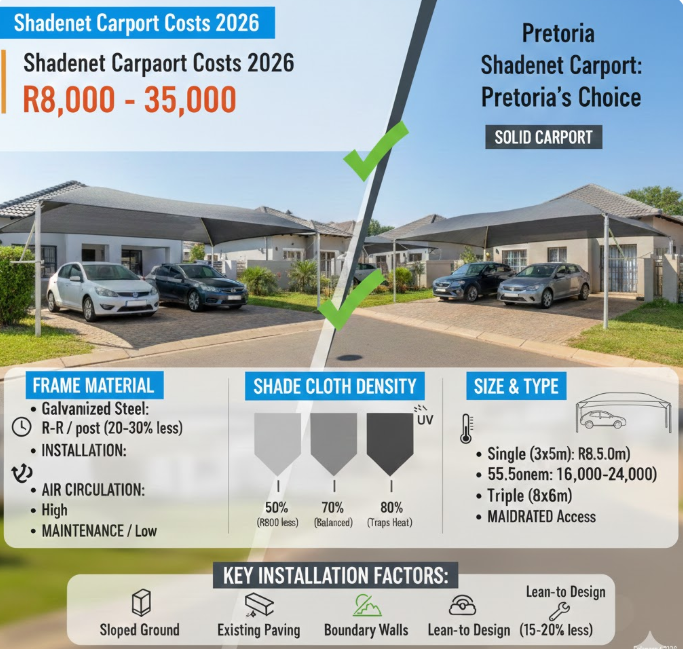
Price Breakdown by Size
| Carport Size | Dimensions | Price Range |
|---|---|---|
| Single | 3m × 5m | R8,500–R13,000 |
| Single (extended) | 3m × 6m | R11,000–R15,500 |
| Double | 5.5m × 5m | R16,000–R24,000 |
| Double (extended) | 5.5m × 6m | R20,000–R28,000 |
| Triple | 8m × 6m | R28,000–R35,000 |
These figures reflect standard installations on level ground with no obstructions. Properties with sloped driveways, existing paving that requires drilling, or proximity to boundary walls often incur additional labour charges.
Material Cost Factors
The frame material creates the most significant price variation. Galvanised steel posts (76mm diameter) offer excellent durability for high-traffic residential areas and cost substantially less than aluminium alternatives. Pronet Shadeports & Carports Gauteng uses heavy-duty steel that withstands Pretoria’s summer hailstorms and winter temperature fluctuations without warping.
Shade cloth quality determines both upfront cost and replacement frequency. Commercial-grade HDPE (high-density polyethylene) fabric with UV stabilisers costs more initially but resists degradation from Pretoria’s intense sunlight. The density percentage affects pricing:
- 50% shade cloth: Entry-level protection, suitable for mild climates
- 70% shade cloth: Balanced UV protection and ventilation
- 80% shade cloth: Maximum heat reduction, recommended for north-facing installations
- 90% shade cloth: Privacy applications, reduces airflow significantly
Installation Considerations for Pretoria Properties
Pretoria’s clay-rich soil requires specific foundation approaches. The expansive clay expands during rain and contracts in dry periods, which can shift poorly anchored posts. Professional installers excavate 600mm–800mm deep footings and use concrete collars around each post to prevent movement. Properties in areas like Waterkloof, Menlyn, and Centurion often have harder subsoil layers that increase excavation difficulty and labour time.
Existing structures affect carport installation costs in several ways. Attaching one side of the carport to a house wall (lean-to design) eliminates two posts and reduces material costs by 15–20%. However, this requires proper flashing installation to prevent water damage to the wall, and not all properties have suitable attachment points that meet structural requirements.
Comparing Shadenet to Alternative Carport Types
Shadenet carports cost 40–60% less than equivalent IBR steel roof carports and roughly half the price of polycarbonate-roofed structures. The installation speed creates additional savings because most shadenet carports complete in under three days, minimising disruption to household routines. Solid-roof carports often take five to seven days when factoring in waterproofing and gutter installation.
The maintenance requirements differ substantially. Shadenet requires annual cleaning with mild detergent and inspection for small tears, which take minutes to repair with patching kits. Steel or polycarbonate roofs need regular checks for rust, seal integrity, and panel damage from falling branches or hail impact.
Gauteng Regional Price Variations
Carport costs in Gauteng remain relatively consistent across the province, but Pretoria installations sometimes cost slightly more than Johannesburg equivalents because of travel distances for suppliers based in industrial areas. Companies operating from Pretoria East or Centurion typically offer better rates for properties in those areas compared to distant suburbs like Hammanskraal or Bronkhorstspruit.
Bulk suburb developments occasionally receive discounted rates when multiple neighbours order simultaneously. Estate managers negotiating group installations for 10 or more units often secure pricing reductions of 8–12% per carport.
Additional Costs to Consider
The quoted shadenet carport price includes materials, labour, and basic installation on prepared ground. However, several factors increase the final amount:
- Concrete slab preparation: R180–R250 per square metre if existing surface is unsuitable
- Electrical conduit installation: R600–R1,200 for lighting circuits in carport roof
- Permit fees: Some Pretoria suburbs require building plan approval (R800–R1,500)
- Gutter systems: Optional rainwater channelling adds R450–R800 per linear metre
- Upgraded posts: Powder-coated finish instead of galvanised adds R300–R500 per post
Properties with security walls close to the installation area may need temporary access arrangements that affect labour scheduling. Narrow side passages that prevent vehicle access for materials delivery sometimes require manual handling, which increases installation time by half a day.
Lifespan and Replacement Economics
Quality shadenet fabric lasts 10–15 years in Pretoria’s climate before UV degradation weakens the weave structure. The steel frame typically outlasts the cloth by another 10–15 years, making fabric replacement the primary maintenance expense. Replacement shade cloth costs R95–R160 per square metre including installation, which means a standard single carport requires R1,900–R3,200 for new fabric after a decade of service.
Calculating total cost of ownership over 20 years shows shadenet carports remain economical even with fabric replacement. A single carport costing R12,000 initially, plus R2,500 for fabric replacement at year 12, totals R14,500 over two decades. Equivalent solid-roof carports costing R22,000 initially still exceed the shadenet total cost despite requiring less frequent maintenance.
Frequently Asked Questions
How long does shadenet carport installation take in Pretoria?
Single carports install in one to two days on level ground with no complications. Double carports typically require two to three days, including foundation excavation, concrete curing time, and final tensioning of the shade cloth. Complex sites with sloped driveways or restricted access may extend installation by an additional day.
Does shade cloth colour affect the price?
Colour selection creates minimal price variation, usually under 5% difference between standard options. Dark colours like charcoal and forest green absorb more heat but hide dirt better, whilst lighter shades like beige reflect sunlight and stay cooler. Most suppliers stock black, charcoal, beige, and green without price premiums.
Can existing carport poles support new shadenet?
Pronet Shadeports & Carports Gauteng evaluates existing structures before recommending reuse. Steel posts in good condition with proper foundations often support new shade cloth, saving R3,000–R5,000 on materials. However, posts with rust damage, concrete deterioration, or inadequate spacing require replacement for structural safety.
Do shadenet carports need council approval in Pretoria?
Most residential shadenet carports under 50 square metres don’t require building plan submission in Pretoria, but homeowners’ association rules and some municipal districts have specific requirements. Properties in heritage areas or near boundary walls sometimes need approval regardless of size. Checking with local authorities before installation prevents potential compliance issues.
What shade cloth density works best for Pretoria summers?
The 80% shade cloth density provides optimal protection for Pretoria’s climate, blocking harmful UV rays whilst maintaining airflow underneath the structure. This density reduces vehicle interior temperatures by 12–15 degrees compared to uncovered parking, preventing dashboard cracking and upholstery fading without creating the stifling environment that 90% cloth produces.
How much weight can shadenet carports hold?
Shadenet carports aren’t designed for load-bearing applications like storage platforms or roof-mounted equipment. The fabric itself supports only its own weight plus wind and light debris loads. Heavy snow accumulation doesn’t occur in Pretoria, but severe hailstorms occasionally deposit ice that slides off the angled, permeable surface without causing structural stress.
Are shadenet carports hail-resistant?
The flexible shade cloth fabric absorbs hail impact better than rigid materials, with small stones passing through the weave and larger hail bouncing off without causing tears. Pronet Shadeports & Carports Gauteng uses reinforced edge hems and high-tensile steel cables that prevent fabric tearing during storms. Golf-ball-sized hail rarely damages properly installed shadenet structures, unlike polycarbonate or IBR sheeting that cracks or dents.