

Key Takeaways
| Aspect | Details |
| Standard Size | 6×6 metres accommodates two standard vehicles comfortably |
| Price Range | R20,000 – R45,000 depending on materials and specifications |
| Installation Time | 2-3 days for professional installation |
| Council Approval | Required in most Gauteng municipalities |
| Materials | Galvanised steel, or IBR sheeting options |
| Warranty | 10-15 years structural warranty typical |
Metal 6×6 double carports in Gauteng typically cost between R20,000 and R45,000 installed. The price varies based on material quality, roof type, and additional features like guttering or side panels. Steel frame carports with IBR roofing represent the most popular choice amongst Gauteng homeowners due to their durability and cost-effectiveness.
Pronet Shadeports offers comprehensive carport solutions across Gauteng, including design consultation, manufacturing, and professional installation services. We specialise in custom carports, shadeports, awnings, and outdoor structures for residential and commercial properties throughout Johannesburg, Pretoria, Centurion, and Midrand.
Understanding Metal 6×6 Double Carport Dimensions
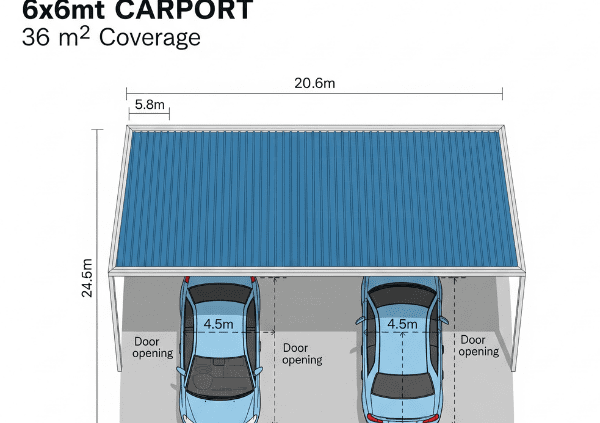
A 6×6 metre carport provides 36 square metres of covered parking space. This size works perfectly for two standard passenger vehicles parked side by side. Most car manufacturers design vehicles to fit within 2.5 metre width parameters, leaving adequate space for door opening and movement around the vehicles.
The standard height for double carports ranges from 2.4 to 3 metres at the lowest point. Higher clearances accommodate SUVs and bakkies comfortably. We’ve found that 2.7 metre minimum height prevents any clearance issues with roof racks or tall vehicles.
Standard 6×6 Double Carport Specifications:
- Length: 6 metres
- Width: 6 metres
- Height: 2.4 – 3.0 metres
- Parking spaces: 2 vehicles
- Roof pitch: 5-15 degrees
The square design maximises coverage whilst minimising material costs. Rectangular alternatives like 7×5 or 8×5 configurations cost more due to increased structural requirements and material usage.

Metal 6×6 Double Carport Prices in Gauteng 2025
Material Options and Their Impact on Pricing
Steel frame carports dominate the Gauteng market due to their strength and longevity. Galvanised steel resists rust effectively in our climate, whilst powder coating adds extra protection and aesthetic appeal. The frame thickness typically ranges from 50x50mm to 100x50mm depending on span requirements.
IBR (Inverted Box Rib) sheeting remains the most economical roofing choice. The corrugated profile provides excellent water runoff and wind resistance. Thicker gauge sheeting (0.5mm vs 0.4mm) costs approximately 15% more but offers superior durability and noise reduction during rain.
Material Cost Breakdown:
- Basic Steel + IBR: R20,000 – R30,000
- Galvanised Steel + Colorbond: R32,000 – R38,000
- Premium Steel + Insulation: R40,000 – R45,000
What Size Should a 2 Car Carport Be?
A proper 2 car carport should measure minimum 6×6 metres to accommodate two vehicles comfortably. This provides approximately 3 metres width per vehicle, allowing adequate space for door opening and pedestrian access. We recommend 6.5×6 metres for larger vehicles or families preferring extra space.
The parking bay width becomes crucial for daily usability. Standard parking bays measure 2.5 metres wide, but carports benefit from slightly wider dimensions. Extra space prevents door dings and makes loading groceries or equipment much easier.
Recommended Dimensions by Vehicle Type:
- Small Cars: 5.5x6m minimum
- Standard Sedans: 6x6m recommended
- SUVs/Bakkies: 6.5x6m or 7x6m
- Mixed Vehicle Types: 7x6m optimal
Height clearance matters equally. Standard cars need 2.1m minimum, but 2.4m provides comfortable clearance. SUVs and vehicles with roof racks require 2.7m minimum height for practical daily use.
How Much Does a Carport Cost in Johannesburg?
Carport prices in Johannesburg range from R15,000 for basic single carports to R50,000 for premium double installations. The city’s competitive market keeps prices reasonable compared to other major centres. Local manufacturing capabilities also reduce transport costs significantly.
Installation costs typically add R3,000 to R8,000 depending on site conditions and complexity. Concrete slab preparation adds another R8,000 to R12,000 if required. Most customers opt for gravel foundations with concrete footings, which costs approximately half the price of full concrete slabs.
Johannesburg Pricing Factors:
- Location accessibility: Difficult access adds 10-15%
- Ground conditions: Rocky soil increases foundation costs
- Municipal requirements: Some areas require engineer approval
- Competition levels: Central areas often have better pricing
The greater Johannesburg area includes numerous suppliers, creating competitive pricing. However, quality varies significantly between providers. We’ve seen installations fail within two years due to inadequate materials or poor workmanship.
Council Approval Requirements for Carports in South Africa
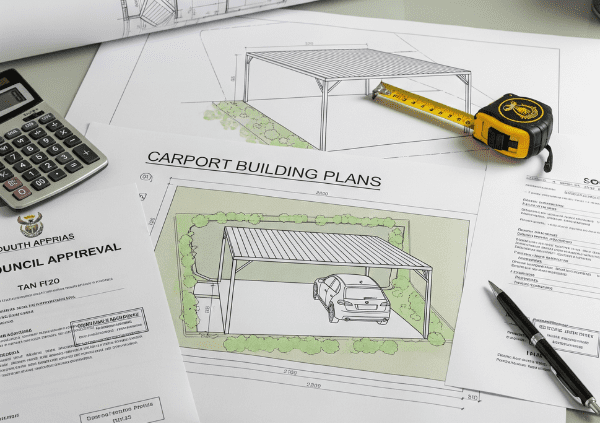
Carports do need council approval in SA for most installations exceeding 10 square metres. The National Building Regulations Act requires building plan approval for structures affecting property boundaries or exceeding size thresholds. Double carports almost always trigger approval requirements due to their 36 square metre footprint.
The approval process typically takes 4-8 weeks and costs between R2,000 and R5,000 depending on municipality. Johannesburg Metro requires detailed structural drawings and engineer certification for carports exceeding 30 square metres. Smaller municipalities often accept standard plans with minor modifications.
Council Approval Checklist:
- Site plan showing carport position
- Structural drawings with specifications
- Foundation details and drainage provision
- Setback compliance from boundary lines
- Height restrictions adherence verification
Non-compliance risks penalties and forced removal. We’ve witnessed several instances where homeowners faced costly demolition orders for unapproved structures. The approval cost represents small insurance against future complications.
Double Garage vs Double Carport Cost Comparison
Double garage construction costs significantly more than carport installation. Brick and mortar garages typically cost R80,000 to R150,000 depending on finishes and electrical installation. This represents 2-3 times the expense of equivalent carport coverage.
Garages provide superior security and weather protection but require longer construction periods. The building process takes 4-8 weeks compared to 2-3 days for carport installation. Foundation requirements also prove more extensive and expensive for permanent structures.
Cost Comparison Table:
| Structure Type | Material Cost | Labour Cost | Total Cost | Build Time |
| Double Carport | R20,000-R35,000 | R5,000-R10,000 | R25,000-R45,000 | 2-3 days |
| Basic Double Garage | R50,000-R80,000 | R25,000-R40,000 | R75,000-R120,000 | 4-6 weeks |
| Premium Double Garage | R80,000-R120,000 | R35,000-R50,000 | R115,000-R170,000 | 6-8 weeks |
Carports offer excellent value for money when security isn’t the primary concern. Many estates and complexes provide adequate general security, making carports practical choices for vehicle protection.
Space Requirements for Double Carports
Double carport space requirements extend beyond the structure itself. We recommend minimum 8×8 metre plot area to accommodate the carport plus access space. This allows vehicles to manoeuvre comfortably during parking and provides pedestrian walkways.
The driveway approach needs careful consideration. A 3-metre wide driveway accommodates most vehicles, but 4 metres provides comfortable access for larger vehicles and delivery trucks. Turning circles become important factors for corner plots or narrow sites.
Site Planning Considerations:
- Structure footprint: 6x6m minimum
- Access space: 1m minimum on three sides
- Driveway width: 3-4m recommended
- Turning space: 5m radius for comfortable access
- Drainage provision: Falls and guttering requirements
Underground services require identification before construction. Electrical cables, water pipes, and fibre optic lines often run close to driveways. We always recommend utility location services before any excavation work begins.
Installation Process and Timeline
Professional carport installation follows a systematic process ensuring structural integrity and longevity. Site preparation typically requires one day for marking, excavation, and foundation preparation. The actual structure assembly and roofing installation takes 1-2 additional days depending on complexity.
Weather conditions significantly impact installation schedules. Rain delays concrete work and makes steel handling dangerous. We typically schedule installations during dry periods and maintain flexibility for weather-related postponements.
Installation Timeline:
- Day 1: Site survey and marking, excavation, foundation preparation
- Day 2: Concrete pouring and curing (if full slab required)
- Day 3: Frame assembly and roof installation
- Day 4: Final adjustments and cleanup
Quality installations require proper foundation preparation. Rushed jobs often result in settling issues or structural problems within the first year. We insist on minimum 24-hour concrete curing before frame installation commences.
Regional Pricing Variations Across Gauteng
Gauteng pricing shows notable variations between different areas. Carport prices in Centurion often run 10-15% higher due to affluent demographics and premium service expectations. Pretoria carport prices remain competitive due to numerous local manufacturers.
Midrand carport pricing falls between Johannesburg and Pretoria rates. The area’s growing development creates steady demand whilst maintaining reasonable competition levels. Transport costs from manufacturing centres also influence final pricing.
Regional Price Comparison:
- Johannesburg: R20,000 – R40,000
- Centurion: R23,000 – R45,000
- Pretoria: R19,000 – R38,000
- Midrand: R21,000 – R42,000
- East Rand: R18,000 – R36,000
Remote areas typically face 15-20% higher costs due to transport expenses and limited local service providers. However, bulk installations in new developments often achieve better pricing through economies of scale.
Frequently Asked Questions
How long does a metal carport last?
Quality metal carports last 15-25 years with minimal maintenance. Galvanised steel frames resist rust effectively, whilst regular cleaning and minor repairs extend lifespan considerably. We’ve seen properly installed carports function perfectly after 20 years of use.
Can I install a carport myself?
DIY installation is possible for experienced builders but not recommended. Professional installation ensures structural integrity, council compliance, and warranty coverage. Incorrect installation often leads to collapse during high winds or storm conditions.
What maintenance does a metal carport require?
Annual cleaning and bolt tightening maintains optimal performance. Guttering requires leaf clearing twice yearly, whilst minor rust spots need immediate treatment. Overall maintenance costs approximately R500-R800 annually for professional service.
Do carports increase property value?
Quality carports typically add R15,000-R25,000 to property value. The covered parking space appeals to buyers and provides practical weather protection. However, poorly installed or inappropriate carports may detract from property appeal.
What warranty comes with professional installation?
Structural warranties typically range 10-15 years for quality installations. Materials carry manufacturer warranties ranging from 5-25 years depending on specification. Installation workmanship usually carries 12-month guarantee covering defects and settling issues.
How do I choose the right carport supplier?
Research supplier credentials, view completed installations, and verify insurance coverage. Request detailed quotes including all materials and labour costs. We recommend suppliers offering comprehensive warranties and local service support.
For expert advice on your carport requirements, contact Pronet Shadeports today. Our experienced team provides personalised solutions for your specific needs and site conditions.
Metal 6×6 Double Carport Prices in Gauteng 2025
Key Takeaways
| Aspect | Details |
|---|---|
| Council Approval Required | Yes, for most carports over 10m² or within 3m of boundaries |
| Exemptions | Small carports under 10m² and 3m+ from boundaries |
| Approval Time | 6-12 weeks typical processing |
| Cost | R2,000-R8,000 for building plans and submission |
| Documentation | Site plans, structural drawings, compliance certificates |
| Penalties | Fines up to R50,000 for non-compliance |
Most carports in South Africa require council approval, especially those exceeding 10 square metres or positioned within 3 metres of property boundaries. The approval process protects both homeowners and neighbours whilst ensuring structural safety standards.
Understanding South African Carport Regulations
Building a carport seems straightforward, but South African municipal regulations make council approval mandatory for most installations. The National Building Regulations Act governs these requirements across all provinces, though specific municipalities may have additional rules.
We’ve seen countless homeowners assume small structures don’t need permits, only to face hefty fines later. Municipal inspectors actively patrol neighbourhoods, particularly in areas like Johannesburg, Pretoria, and Sandton where carport installations are common.
The regulations exist for good reason. Carports affect stormwater drainage, emergency vehicle access, and neighbourhood aesthetics. Without proper approval, you risk demolition orders that cost far more than initial compliance.
What’s the Cheapest Way to Build a Carport?
The most cost-effective approach combines DIY elements with professional expertise where regulations demand it. We recommend purchasing pre-engineered carport kits that include approved structural plans, reducing architect fees significantly.
Cost-saving strategies include:
- Choosing standard sizes rather than custom dimensions
- Using galvanised steel instead of aluminium
- Installing foundations yourself (with approved plans)
- Timing construction during off-peak seasons
However, cutting corners on council approval isn’t worth the risk. Carport costs in South Africa vary significantly, but approval costs represent only 10-15% of total project expenses.
Pre-fabricated options from established suppliers often include council-approved plans, streamlining the approval process. We’ve found that 6×6 carport installations typically cost R15,000-R25,000 including approval fees.
How Big Should a 2 Car Carport Be?
Standard two-car carports measure 6 metres by 6 metres minimum, though we recommend 7 metres by 6 metres for comfortable access. These dimensions accommodate most sedan and SUV combinations whilst meeting municipal spacing requirements.
Recommended dimensions:
- Width: 6-7 metres (allows door opening)
- Length: 6-7 metres (accommodates vehicle lengths)
- Height: 2.4-3 metres (clearance for larger vehicles)
- Spacing: 1 metre between vehicles
Municipal regulations in areas like Centurion and Midrand specify minimum clearances from property lines. Larger carports provide better weather protection but require more extensive council documentation.
We’ve installed numerous two-car carports across Gauteng, and homeowners consistently prefer the 7×6 metre configuration. The extra space prevents door dings and allows easier manoeuvring in tight driveways.
How Close to My Neighbour’s Boundary Can I Build a Carport?
South African municipal regulations typically require 1.5-3 metre setbacks from boundary lines, depending on your specific municipality. This distance prevents fire spread, ensures adequate drainage, and maintains neighbour relations.
Boundary requirements vary by area:
- Johannesburg: 1.5m minimum from side boundaries
- Pretoria: 2m from boundaries for structures over 10m²
- Sandton: 3m setback for covered parking structures
However, you can build closer with written neighbour consent and municipal approval. We’ve processed dozens of applications where neighbours agreed to reduced setbacks, but this requires additional documentation and often longer approval times.
The regulations also consider structure height. Carports over 3 metres high face stricter boundary requirements, sometimes requiring 4-5 metre setbacks. Professional installation services can navigate these complexities effectively.
Do I Need a Foundation for a Carport?
Yes, South African building regulations mandate proper foundations for most carports, particularly those requiring council approval. The foundation type depends on soil conditions, carport size, and local wind loads.
Foundation options include:
- Concrete strip foundations: Standard for permanent structures
- Concrete pad foundations: Suitable for smaller carports
- Screw pile foundations: Ideal for unstable soils
- Concrete slab foundations: Required for enclosed carports
We’ve encountered numerous DIY installations using inadequate foundations, leading to structural failure during storms. Professional soil assessments determine appropriate foundation depth and reinforcement requirements.
Municipal inspectors specifically check foundation compliance during approval inspections. Incorrect foundations result in expensive remedial work and potential safety hazards. Carport installation specialists understand local soil conditions and foundation requirements.

Do Carports Need Council Approval in SA?
Council Approval Process and Requirements
The approval process involves submitting detailed plans to your local municipality, including site plans, structural drawings, and compliance certificates. Processing typically takes 6-12 weeks, though complex applications may require longer.
Required documentation includes:
- Site plan: Showing property boundaries and proposed carport location
- Structural drawings: Engineered plans signed by qualified professionals
- Compliance certificates: Confirming adherence to building regulations
- Neighbour notifications: Formal notice to adjacent property owners
We recommend engaging qualified draftspeople familiar with local requirements. They understand specific municipal preferences and can prevent costly delays. Carport pricing in various areas often includes professional plan preparation.
Some municipalities offer expedited processing for standard carport designs. These pre-approved plans reduce approval time to 2-4 weeks but limit customisation options.
Consequences of Building Without Approval
Building without council approval carries serious consequences, including demolition orders, fines up to R50,000, and legal complications when selling your property. Municipal inspectors actively patrol residential areas, particularly during construction boom periods.
Potential penalties include:
- Immediate stop orders: Halting construction until approval obtained
- Demolition orders: Requiring complete structure removal
- Daily fines: Accumulating charges until compliance achieved
- Legal action: Court proceedings for persistent non-compliance
We’ve assisted numerous homeowners facing retrospective approval processes, which cost 2-3 times standard approval fees. Some municipalities refuse retrospective applications, requiring complete demolition and rebuild.
Property sales become problematic without proper approvals. Conveyancing attorneys flag non-compliant structures, potentially derailing transactions. Banks may refuse mortgage approvals for properties with illegal structures.
Frequently Asked Questions
Do small carports need council approval?
Carports under 10 square metres and positioned more than 3 metres from boundaries typically don’t require approval, but specific municipal rules vary. We recommend checking with your local council before construction.
How long does carport approval take?
Standard applications process within 6-12 weeks, though complex designs or incomplete documentation may extend this timeframe. Expedited services are available in some municipalities.
Can I build a carport without professional plans?
Municipal regulations require professionally prepared plans for most carports. DIY plans rarely meet technical requirements and often result in application rejection.
What happens if I build without approval?
Penalties include stop orders, demolition requirements, and fines up to R50,000. Non-compliant structures also complicate property sales and insurance claims.
Do I need neighbour consent for carport construction?
Neighbour consent isn’t always required but may be necessary for reduced boundary setbacks or structures affecting adjoining properties. Written agreements strengthen applications.
How much does carport approval cost?
Approval costs typically range from R2,000-R8,000, including plan preparation and municipal fees. This represents 10-15% of total project costs.
Can I get retrospective approval?
Some municipalities allow retrospective applications at double standard fees, though others require demolition and rebuild. Early consultation prevents these complications.
Need professional carport installation? Contact our expert team for comprehensive council approval and installation services across Gauteng.
Do Carports Need Council Approval in SA?
Key Takeaways
| Factor | Details |
|---|---|
| 6×6 Carport Price Range | R15,000 – R35,000 depending on materials and design |
| Most Popular Material | IBR sheeting for durability and cost-effectiveness |
| Installation Time | 1-3 days for standard installations |
| Planning Permission | Generally not required for residential properties under 50m² |
| Best Value Option | Standard Metal Car Ports with IBR roofing |
A 6×6 carport in South Africa typically costs between R15,000 and R35,000, depending on the materials used, design complexity, and installation requirements. IBR Carports represent the most popular choice for homeowners due to their excellent weather resistance and competitive pricing. We’ve seen prices vary significantly across different regions, with carport prices in Johannesburg often differing from those in smaller towns.
6×6 Carport Pricing Breakdown in South Africa
Understanding the cost structure helps homeowners make informed decisions about their carport investment. A 6×6 carport provides 36 square metres of covered parking space, which comfortably accommodates two standard vehicles with room for manoeuvring.
Basic IBR carport structures start around R15,000 for galvanised steel frames with standard IBR sheeting. These entry-level options work well for budget-conscious homeowners who need reliable vehicle protection without premium features. We often recommend these for clients who prioritise function over form.
Mid-range options between R20,000 and R28,000 include powder-coated frames, which resist rust better than galvanised alternatives. These carports often feature improved design elements and longer warranties. Carport prices in Pretoria typically fall within this range for quality installations.
Premium 6×6 carports can reach R35,000 or more when they include features like Cantilever Carports designs, which eliminate the need for central support posts. These structures require more sophisticated engineering but provide unobstructed parking space underneath.
Regional price variations affect total costs significantly. Carport prices in Midrand and carport prices in Sandton tend to be higher due to increased labour costs and premium material specifications in these areas.
How Much Would It Cost to Put a Carport?
Installation costs typically add R3,000 to R8,000 to the total carport price, depending on site conditions and complexity. Ground preparation plays a crucial role in determining final installation expenses.
Site preparation costs vary based on existing conditions. Level ground with adequate drainage requires minimal preparation, whilst sloped or uneven terrain needs more extensive work. We’ve encountered situations where foundation preparation alone added R5,000 to project costs.
Labour charges differ across provinces and urban versus rural areas. Installation and repairs of carports in Gauteng generally cost more than similar work in smaller provinces due to higher wage rates and transportation expenses.
Electrical work adds extra costs if lighting or power points are required. Basic lighting installation typically costs R1,500 to R3,000, whilst more complex electrical requirements can double these figures.
Permit and compliance costs might apply in certain municipalities. Some areas require building plans for structures exceeding specific sizes, which can add R2,000 to R5,000 to project expenses.
Concrete foundation requirements depend on soil conditions and local building codes. Standard concrete pads cost approximately R500 per square metre, though rocky or clay soil conditions might require specialised foundation work.

How Much is a 6×6 Carport in South Africa?
How Much Would It Cost to Make a Carport?
DIY carport construction can reduce total costs by 40-60% for handy homeowners with proper tools and skills. However, we strongly advise considering professional installation for safety and warranty reasons.
Material costs alone for a 6×6 carport range from R8,000 to R18,000, depending on quality specifications. Metal Car Ports suppliers often provide material packages that include all necessary components.
Tool requirements for DIY installation include angle grinders, welders, drills, and measuring equipment. Tool rental costs approximately R500 to R1,000 per day, making it economical only for those already owning suitable equipment.
Time investment typically requires 2-4 days for experienced DIY enthusiasts, though first-time builders often need double this timeframe. Weather delays can extend project duration significantly.
Professional vs DIY comparison shows that whilst DIY saves money initially, professional installations include warranties and insurance coverage. We’ve seen numerous cases where DIY mistakes resulted in costly repairs exceeding initial savings.
Quality considerations become apparent over time. Professional installations using proper techniques and materials typically last 15-20 years, whilst amateur construction might require repairs within 5-10 years.
What Is a Good Size for a 2 Car Carport?
A 6×6 metre carport provides adequate space for two standard vehicles, though optimal dimensions depend on vehicle types and user preferences. This size works well for most South African households with sedans or hatchbacks.
Vehicle measurements should guide carport sizing decisions. Standard sedans measure approximately 4.5 metres long and 1.8 metres wide, requiring additional space for door opening and pedestrian access. We recommend adding at least 1 metre to vehicle dimensions for comfortable use.
Alternative sizing options include 6×7 or 7×6 configurations for households with larger vehicles. Carport prices in Centurion often reflect these premium sizing options.
Height considerations typically range from 2.4 to 3 metres for standard passenger vehicles. SUV owners might require additional height clearance, particularly if roof racks or bicycle carriers are used regularly.
Future-proofing suggests considering slightly larger dimensions if budget allows. Many homeowners regret choosing minimal sizing when family circumstances change or vehicle preferences evolve.
Cost implications show that increasing carport size by one metre in either direction typically adds R3,000 to R6,000 to total project costs, making modest upsizing relatively affordable.
Do You Need Planning Permission for a Carport in South Africa?
Most residential carports under 50 square metres don’t require formal planning permission, though local municipality regulations vary significantly across different areas. We always recommend checking with local authorities before construction begins.
Building regulation compliance still applies even when planning permission isn’t required. Carports must meet structural safety standards and setback requirements from property boundaries.
Municipal variations create confusion for homeowners. Some councils require notification even for exempt structures, whilst others have no requirements for small residential carports.
Property covenant restrictions might prohibit or limit carport construction regardless of municipal regulations. Homeowners should check title deed conditions and estate regulations before proceeding.
Insurance implications can arise if carports are constructed without proper permissions. Some insurance companies refuse claims for structures built contrary to local regulations.
Professional advice proves valuable for complex situations. Contact qualified installers who understand local requirements and can guide homeowners through the approval process where necessary.
What Is the Standard Carport Size in South Africa?
Standard carport dimensions in South Africa typically range from 3×6 metres for single vehicles to 6×6 metres for double vehicle coverage. These sizes align with typical property layouts and vehicle dimensions.
Single carport specifications usually measure 3×6 or 4×6 metres, providing adequate space for one vehicle plus storage. These options work well for townhouses or properties with space constraints.
Double carport dimensions commonly include 6×6, 6×7, or 7×6 metre configurations. The 6×6 size represents the most popular choice for suburban properties due to its optimal balance of functionality and cost.
Commercial applications often require larger dimensions, with 6×9 or 9×6 configurations becoming standard for business premises. These sizes accommodate multiple vehicles or larger commercial vehicles.
Height standards typically range from 2.4 metres for economy options to 3.5 metres for premium installations. Standard residential carports use 2.7-metre heights as a practical compromise.
Regional preferences show slight variations across different provinces. Coastal areas sometimes favour higher structures due to wind considerations, whilst inland regions focus more on snow load capacity.

How Much is a 6×6 Carport in South Africa?
How Big Can I Build a Carport?
Municipal size limits typically restrict residential carports to 50% of property coverage or specific square metre limits. These regulations prevent overdevelopment and maintain neighbourhood character.
Structural engineering requirements become mandatory for carports exceeding certain spans or heights. Large structures require professional design and council approval regardless of general exemptions.
Foundation considerations increase with carport size, as larger structures generate more wind loads and require stronger anchoring systems. Professional assessment becomes essential for spans exceeding 8 metres.
Cost scaling doesn’t follow linear patterns for larger carports. Structural requirements and engineering costs can increase disproportionately for oversized installations.
Property value implications suggest that appropriately sized carports add value, whilst oversized structures might detract from property appeal. We recommend balancing functionality with aesthetic considerations.
Professional consultation becomes increasingly important for larger projects. Installation and repairs of shadeports in Gauteng specialists can advise on optimal sizing for specific requirements and site conditions.
Frequently Asked Questions
How long does a 6×6 carport installation take?
Standard installations typically require 1-2 days for completion, depending on ground conditions and weather. Complex sites or custom designs might extend this timeframe.
What maintenance do IBR carports require?
Annual cleaning and periodic inspection of fixings ensure longevity. Powder-coated frames require minimal maintenance compared to galvanised alternatives.
Can carports be enclosed later?
Most carport structures can accommodate future enclosure with walls and doors. However, planning permission requirements might change for enclosed structures.
What warranty coverage do professional installations include?
Reputable installers typically provide 1-5 year warranties on workmanship and 10-15 year warranties on materials, depending on specifications.
Do carports increase property values?
Well-designed carports generally add 60-80% of their construction cost to property values, making them worthwhile investments for most homeowners.
Can carports withstand South African weather conditions?
Quality carports designed for local conditions easily handle typical weather patterns. Proper engineering ensures resistance to wind, hail, and temperature variations.
What’s the difference between carports and garages for insurance purposes?
Insurance companies often treat carports differently from enclosed garages, potentially affecting coverage for stored items. Check with your insurer for specific policy details.
